Goods must be correctly secured to the flatbed before driving the vehicle. Make sure that it is not possible for the goods to move during transit. Failure to do so can lead to serious injury to the driver, other road users, or other personnel.
The driver of the vehicle is responsible for ensuring that goods are correctly secured to the flatbed. Provided below are some simple guidelines describing five ways to secure a load onto the flatbed. The information provided in this section is sourced from the following document:
European Union, 2014. European Best Practices Guidelines, Cargo securing for Road Transport.
The document is available from the following Link: Cargo Securing for Road Transport. The information provided below is not a complete reference and is intended as a guide only. Please refer to the original document for a more detailed explanation.
Required Lashing Equipment
The information provided in this chapter is based on the requirement that the lashing equipment used fulfills the criteria listed below. If other lashing equipment is used, the information provided in all tables in this chapter is not correct.
- Lashing points resist 2000 daN (2 tons under stress).
- Lashings have a LC (Lashing Capacity) of 1600 daN.
- Lashings have a STF (Standard Tension Force) = 400 daN. They must be tightened to a minimum of 400 daN during transport.
How to use this Guide
In order to use the information provided in this chapter, both the friction value for sliding and a ratio for tipping are required for the cargo. These are discussed below. Once these values are attained it is then possible to extract the correct information from the tables provided in this chapter.
Sliding
The friction between the cargo and the loading platform (or cargo beneath it) has a huge influence on how much one lashing can prevent from sliding.
The table in "Appendix - Friction Factors" gives the typical friction factors for common combinations of materials contacting each other or the vehicle load platform.
The values in the table are valid for dry and wet surfaces when the contact surfaces are clean, undamaged and without frost, ice or snow. If this is not the case, then a friction factor μ = 0.2 should be used. Special precautions must be taken if the surfaces are oiled or greasy.
In case of direct lashings, where the cargo may move a little before the elongation of the lashings provides the desired restraint force, the dynamic friction applies, which is to be taken as 75% of the friction factor.
Tipping
 To find out the maximum cargo weight prevented from tipping, a calculation must first be done. This is then used to find the correct information in the tables within this chapter.
If the cargo item has a centre of gravity close to the centre of the cargo, the following calculation is required:

The calculations must be rounded up to the nearest higher value shown in the tables within this chapter.
 If the cargo item has a centre of gravity that is outside the centre of the cargo item, the following calculation is required:

H = Distance up to the centre of gravity
L = Distance according to the diagram
B = Shortest distance between the centre of gravity and the sideways tipping point
Securing Load Methods
Provided below are a number of methods that can be used to secure a load. Use the necessary method or combination of methods to ensure that a load is secure.
 Blocking
Blocking involves positioning the cargo, or parts of the cargo directly to the headboard, sideboards, stanchions, supports, walls or parts of the cargo to stop it from moving. In case of global blocking, the sum of void spaces in any horizontal direction should not exceed 15 cm. However, between dense and rigid cargo items, such as steel, concrete or stone, void spaces should be further minimized, as far as possible.
If the cargo is blocked to a sufficient height, this will effectively stop it from sliding and tipping. If the cargo is only bottom blocked, lashing may be needed to prevent tipping.
 Top-over Lashing
Using the table below, you must note that the angle between the lashing and the loading platform is of great importance. The tables should be used for angles between 75° and 90°. If the angle is between 30° and 75° double amount of lashing straps are needed, or you halve the table values. If the angle is less than 30°, then another method of securing the cargo should be used.
| Cargo weight in ton prevented from sliding per top-over lashing | |||
|---|---|---|---|
| Friction factor μ* | Sideways | Front | Rear |
| 0.15 | 0.31 | 0.15 | 0.31 |
| 0.2 | 0.48 | 0.21 | 0.48 |
| 0.25 | 0.72 | 0.29 | 0.72 |
| 0.3 | 1.1 | 0.38 | 1.1 |
| 0.35 | 1.7 | 0.49 | 1.7 |
| 0.4 | 2.9 | 0.63 | 2.9 |
| 0.45 | 6.4 | 0.81 | 6.4 |
| 0.5 | no risk | 1.1 | no risk |
| 0.55 | no risk | 1.4 | no risk |
| 0.6 | no risk | 1.9 | no risk |
| 0.65 | no risk | 2.7 | no risk |
| 0.7 | no risk | 4.4 | no risk |
*Refer to "Sliding" for information about this value.
 Loop Lashing
A loop lashing will secure a cargo item on each side with a pair of webbings. At the same time the cargo will be prevented from tipping.
At least two loop lashings per long cargo item should be used.
If the cargo item contains more than one section and the sections support each other and stop any twisting from occurring, then only one loop lashing per section of the cargo, may be needed.
| Cargo weight in ton prevented from sliding per pair of loop lashing | |||
|---|---|---|---|
| Friction factor μ* | Sideways | Friction factor μ* | Sideways |
| 0.15 | 4.7 | 0.45 | 13 |
| 0.2 | 5.4 | 0.5 | no risk |
| 0.25 | 6.2 | 0.55 | no risk |
| 0.3 | 7.3 | 0.6 | no risk |
| 0.35 | 8.7 | 0.65 | no risk |
| 0.4 | 11 | 0.7 | no risk |
*Refer to "Sliding" for information about this value.
| Cargo weight in ton prevented from tipping per pair of loop lashing | |||||
|---|---|---|---|---|---|
| Sideways | |||||
| H/B* | 1 row | 2 rows | 3 rows | 4 rows | 5 rows |
| 0.6 | no risk | no risk | no risk | 6.5 | 4.1 |
| 0.8 | no risk | no risk | 5.6 | 3.1 | 2.3 |
| 1 | no risk | no risk | 3.1 | 2 | 1.6 |
| 1.2 | no risk | 4.6 | 2.1 | 1.5 | 1.3 |
| 1.4 | no risk | 3 | 1.6 | 1.2 | 1 |
| 1.6 | no risk | 2.2 | 1.3 | 1 | 0.86 |
*Refer to "Tipping" for information about this value.
 Direct Lashing
Lashings must be fixed within the green angles, as shown in the diagram. This will ensure that they secure the individual cargo item in accordance with the table values.
 The areas where you can attach lashing straps are limited by two straight lines running diagonally through the centre of gravity at an angle of 45°.
| Cargo weight in ton prevented from sliding per straight lashing | |||||||
|---|---|---|---|---|---|---|---|
| μ* | Sideways | Front | Rear | μ* | Sideways | Front | Rear |
| 0.15 | 1.5 | 0.82 | 1.5 | 0.45 | 5.4 | 1.9 | 5.4 |
| 0.2 | 1.8 | 0.95 | 1.8 | 0.5 | no risk | 2.2 | no risk |
| 0.25 | 2.2 | 1.1 | 2.2 | 0.55 | no risk | 2.6 | no risk |
| 0.3 | 2.6 | 1.3 | 2.6 | 0.6 | no risk | 3 | no risk |
| 0.35 | 3.3 | 1.4 | 3.3 | 0.65 | no risk | 3.5 | no risk |
| 0.4 | 4.2 | 1.7 | 4.2 | 0.7 | no risk | 4.2 | no risk |
*Refer to "Sliding" for information about this value.
| Cargo weight in ton prevented from tipping per straight lashing | ||||
|---|---|---|---|---|
| H/B* | Sideways | H/L | Forwards | To the rear |
| 1.2 | no risk | 1.2 | no risk | no risk |
| 1.4 | no risk | 1.4 | 8.2 | no risk |
| 1.6 | no risk | 1.6 | 3.8 | no risk |
| 1.8 | no risk | 1.8 | 2.6 | no risk |
| 2 | no risk | 2 | 2 | no risk |
| 2.2 | 4.1 | 2.2 | 1.7 | 13 |
| 2.4 | 3.2 | 2.4 | 1.5 | 6.9 |
| 2.6 | 2.6 | 2.6 | 1.4 | 4.9 |
| 2.8 | 2.3 | 2.8 | 1.2 | 3.9 |
*Refer to "Tipping" for information about this value.
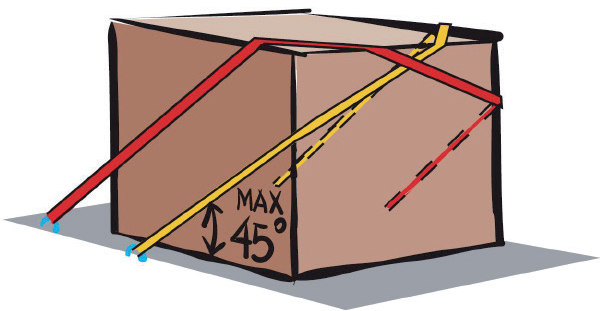 Spring Lashing
A spring lashing is used to stop movement of a cargo item forwards and/or towards the rear.
It is important that the angle between the loading platform and the lashing strap does not exceed 45°.
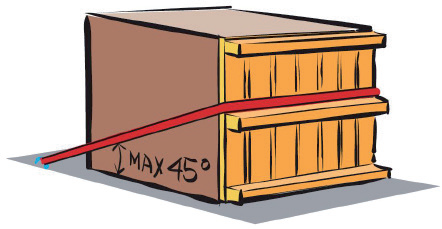 The spring lashing can be done in many ways. However, if the lashing is not applied to the upper edge of the cargo item, the tipping limits of the cargo weight is reduced.
For example, if the spring lashing is placed half way up the cargo item, then it will only secure half the cargo weight indicated in the table.
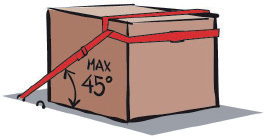 This spring lashing setup has two legs on each side, which secures twice the weight that is indicated in the table.
| Cargo weight in ton prevented from sliding per spring lashing | |||||
|---|---|---|---|---|---|
| μ* | Front | Rear | μ* | Front | Rear |
| 0.15 | 3.7 | 6.6 | 0.45 | 6.7 | 19 |
| 0.2 | 4.1 | 7.6 | 0.5 | 7.5 | no risk |
| 0.25 | 4.5 | 8.8 | 0.55 | 8.4 | no risk |
| 0.3 | 4.9 | 10 | 0.6 | 9.6 | no risk |
| 0.35 | 5.4 | 12 | 0.65 | 11 | no risk |
| 0.4 | 6 | 15 | 0.7 | 13 | no risk |
*Refer to "Sliding" for information about this value.
| Cargo weight in ton prevented from tipping per spring lashing | ||
|---|---|---|
| H/L* | Front | Rear |
| 1.2 | no risk | no risk |
| 1.4 | 54 | no risk |
| 1.6 | 26 | no risk |
| 1.8 | 19 | no risk |
| 2 | 15 | no risk |
| 2.2 | 13 | 101 |
| 2.4 | 12 | 55 |
| 2.6 | 11 | 40 |
| 2.8 | 10 | 32 |
| 3 | 9.9 | 28 |
| 3.2 | 9.5 | 25 |
*Refer to "Tipping" for information about this value.